
What Backrooms Gets About Audiences
Netflix rejected my novel for lacking sufficiently concrete dramatic hooks for a broad audience. The success of Backrooms raises the question whether audiences actually want less explanation, not more

If one film shows just how Hollywood is trying to catch up with online culture, it is the horror movie Backrooms, which premiered in my country last week. The director, Kane Parsons, is only twenty years old and gained cult status on YouTube as a teenager through his nightmarish videos of abandoned, labyrinthine spaces. Famous horror producers James Wan (The Conjuring) and Osgood Perkins (Longlegs) directly recognized his talent and and brought him on to direct a feature film with a budget of ten million dollars.
Parsons did not, however, create the Backrooms phenomenon. It originated on 4chan in 2019, where unsettling snapshots of endless, empty office spaces spawned a vast online mythology. Its rise during the COVID years was hardly accidental. Teenagers like Parsons found themselves staring out at deserted streets, shops, office buildings, wondering: Where was everyone? Would the world ever feel normal again?

Totally unfamiliar with the internet phenomenon, I found myself overwhelmed yesterday in a cinema full of twenty-somethings who knew exactly where things were heading. This brief review will omit spoilers; you really should go see the film for yourself, preferably as open-minded as I was. Let me just say that since The Blair Witch Project, I have seen few horror films that have managed to find such a surprising, new entry point into the nightmare. In Backrooms, the main characters wander through a maze of windowless rooms. That analog intimacy initially presents itself as familiar and slightly sedate, but it becomes increasingly unsettling. The question arises whether there is ever a way back.
Aside from its restraint in over-explanation, the strength of this film lies in its rugged design. The unease is left unfiltered. There is no slick CGI technology here, which is used so frequently that it has achieved the habituation so disastrous to the thrill of being horrified. In Backrooms, we are back to square one, trapped in our outdated, jumbled memories.
The film enthusiast will recognize the depiction of trauma and regret in Andrei Tarkovsky’s Solaris, the witty hopelessness of David Lynch’s short film The Grandmother, and a play with unreliable dimensions that is nothing new either. For instance, the protagonists in Natalie Erika James’ Relic and David Koepp’s You Should Have Left (both from 2020) also get lost in a house that behaves impossibly.
Years ago, before You Should Have Left was adapted into a film, I spent an evening drinking with the author of the book, Daniel Kehlmann. We had appeared together on a panel at the Crossing Border Festival, and the reason we kept ordering vodka was a shared interest in horror films, something that was still looked down upon in literary circles at the time. At least, that is how it felt to me—the aversion may also have stemmed from the fact that writing good literary horror is simply incredibly difficult.
In my latest novel, De bandagist (The bandager), the protagonist, Joost, first falls outside his own ethereal era, only to subsequently become crushed between the rotting legs and the immense libraries of the patients he must care for. Their houses are large and incomprehensible and will, due to the Dutch housing crisis, always remain unreachable to him. The precarious position he finds himself in is ultimately my fault; after all, as a writer, it was me who wrote him into this book, pinning him down as the character of yet another novel that will be cast aside unread for the binge-watching of a Netflix series.
Incidentally, however positively this novel—rather plot-driven by my standards—was received (notably being named Best Novel of the Year by the leading Dutch newspaper De Volkskrant), the Director of Original Series at Netflix Benelux rejected it when she received the manuscript from my publisher. The Bandager, unfortunately, offered “insufficient concrete dramatic tools” for a film or series: “That is due to our ambition to produce series for as broad a Dutch audience as possible.” And so Joost disappeared, along with so many other characters, crumpled and yellowed, into the street dumpster.
Fans of Backrooms, however, are not bothered at all by the lack of concrete dramatic anchors; on the contrary, it drives their imagination wild. The more enigmatic, the better. Funnily enough, the drama of both stories lies precisely in the absence of anchors in our hurried online world. The rooms Joost must visit in The Bandager to care for his sick patients also reflect their mental state, while he stares from his time-frozen attic room at the life outside, in which he no longer believes.
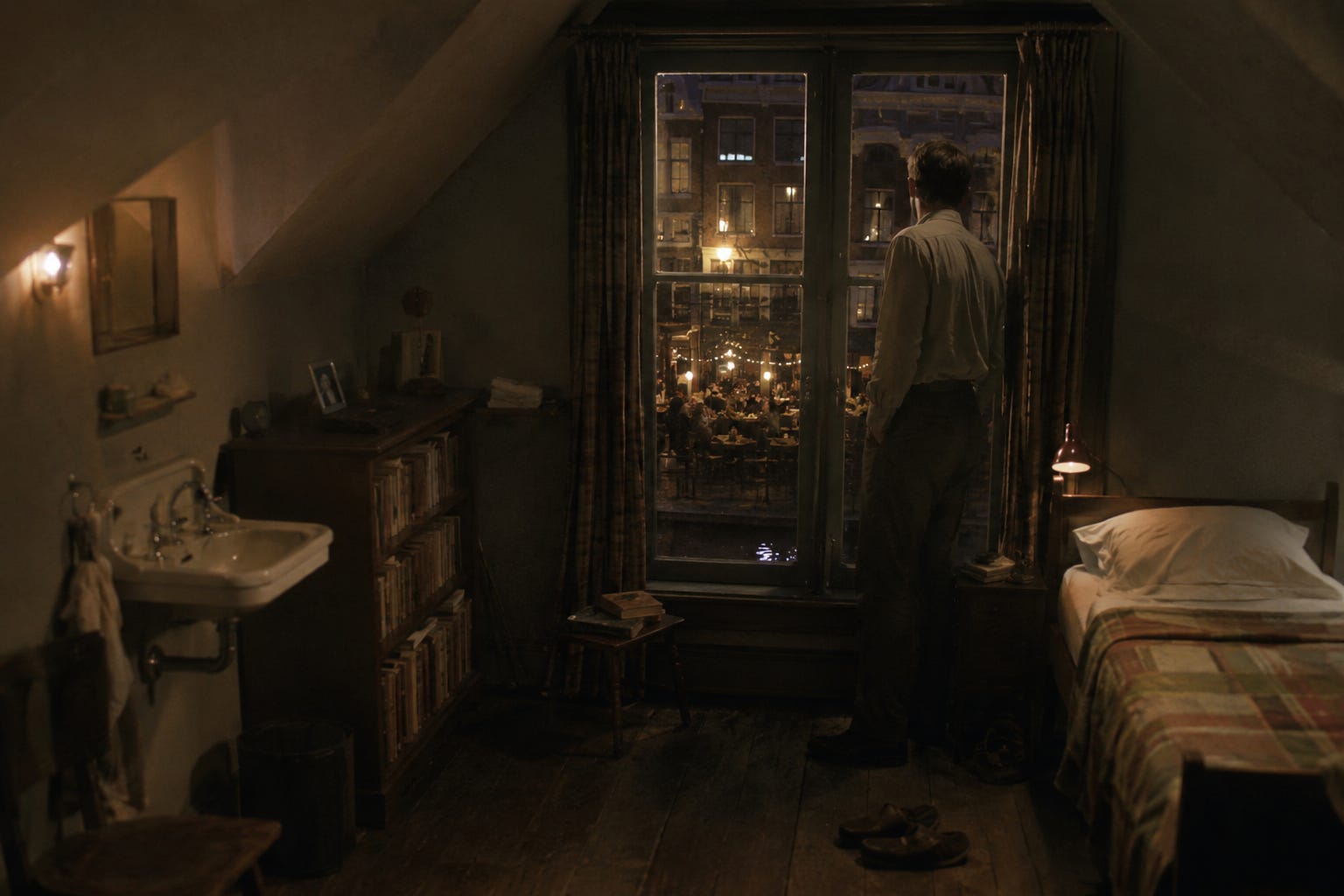
Another great thing about Backrooms is that the main characters are not the usual tough teenage girls with Ouija boards, whom Netflix’s horror algorithms seem to have been prescribing to us for the past ten years. The protagonists, portrayed empathetically by Chiwetel Ejiofor and Renate Reinsve, are middle-aged. Not exactly positive heroes in the prescribed mould, but insecure strugglers like you and me, stuck in life. And the young audience in the cinema eagerly immerses itself in their story.
Perhaps, in a last-ditch attempt to save my character from oblivion, I should turn to a scriptwriting AI bot. The German AI company Black Forest Labs was rewarded this week with a partnership with Martin Scorsese, in what many perceived as an attempt to give actors and screenwriters one final push toward the abyss. Which human being can even keep up with writing about it all?