How AI Got Me Drunk
Life, duplicated and running in circles

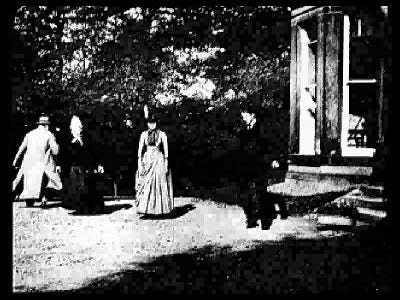
My 2013 novel Roundhay Garden Scene tells the story of a vanished film pioneer in 1890. I modelled him on Louis Le Prince, who disappeared on his way to patent a new camera, before Thomas Edison walked away with the glory. I was fond of the irony: the very man who succeeded in capturing moving images vanishes from view himself. I decided to give him a fear of his own invention. He flees from the technology that would ultimately ensure that no moment could ever again escape our urge to record it.
The third part of the novel is narrated by his son, who sets out in search of his missing father. Afterwards, I dedicated the book to my own father, who died when I was nineteen.
That restless fin de siècle, propelled by the practical application of electricity and a succession of great inventions, bears a striking resemblance to our own age. So does the fear of new technology. Opposing the Church, which regarded photography as the work of the Devil, was a commercial world that advertised it as a means of transcending death. “Replay your loved ones forever—even after they are gone!” If a photograph had not been taken in time, the deceased would be dressed up in their Sunday best to pose for a post-mortem. The result was often more uncanny than comforting, especially once those images began to move, jerkily and hasty across the screen.
Like the son in my novel, who sought to expand the archive left behind by his missing father, I still continue to search for new traces of my dad. They may come in the form of anecdotes told by others, or photographs thought long lost. The temptation of AI—to bring him back to life virtually—proved irresistible.
I uploaded a photograph of my father to ChatGPT, accompanied by a carefully worded request. Knowing the system’s questionable taste, I asked it to alter only something minor: the background perhaps, or just the pose. Despite that precaution, the result was both astonishing and unsettling. What appeared on my screen was not merely sharper than any photograph I had of him; it was unmistakably contemporary. There he was: my father in twenty-first-century resolution.
In the days that followed, the image insinuated itself into my thoughts and dreams. Its hyperreal clarity began to displace something more fragile. I began to worry I had overwritten a genuine memory—that I had replaced something lived with something digital, belonging to a world my father never inhabited.
Now that reality itself seems increasingly elusive, I sometimes wonder whether we should return to a time when uncertainty was granted the same space as hard facts. I have a weakness for antique works of non-fiction, in which science cheerfully coexists with tall tales. In Natural History in Anecdote, for example, one encounters the following account of an orangutan:
“I have seen him sit down at table, when he would unfold his towel, wipe his lips, use a spoon to carry his victuals to his mouth, pour his liquor into a glass, and make it touch that of a person who drank along with him.”
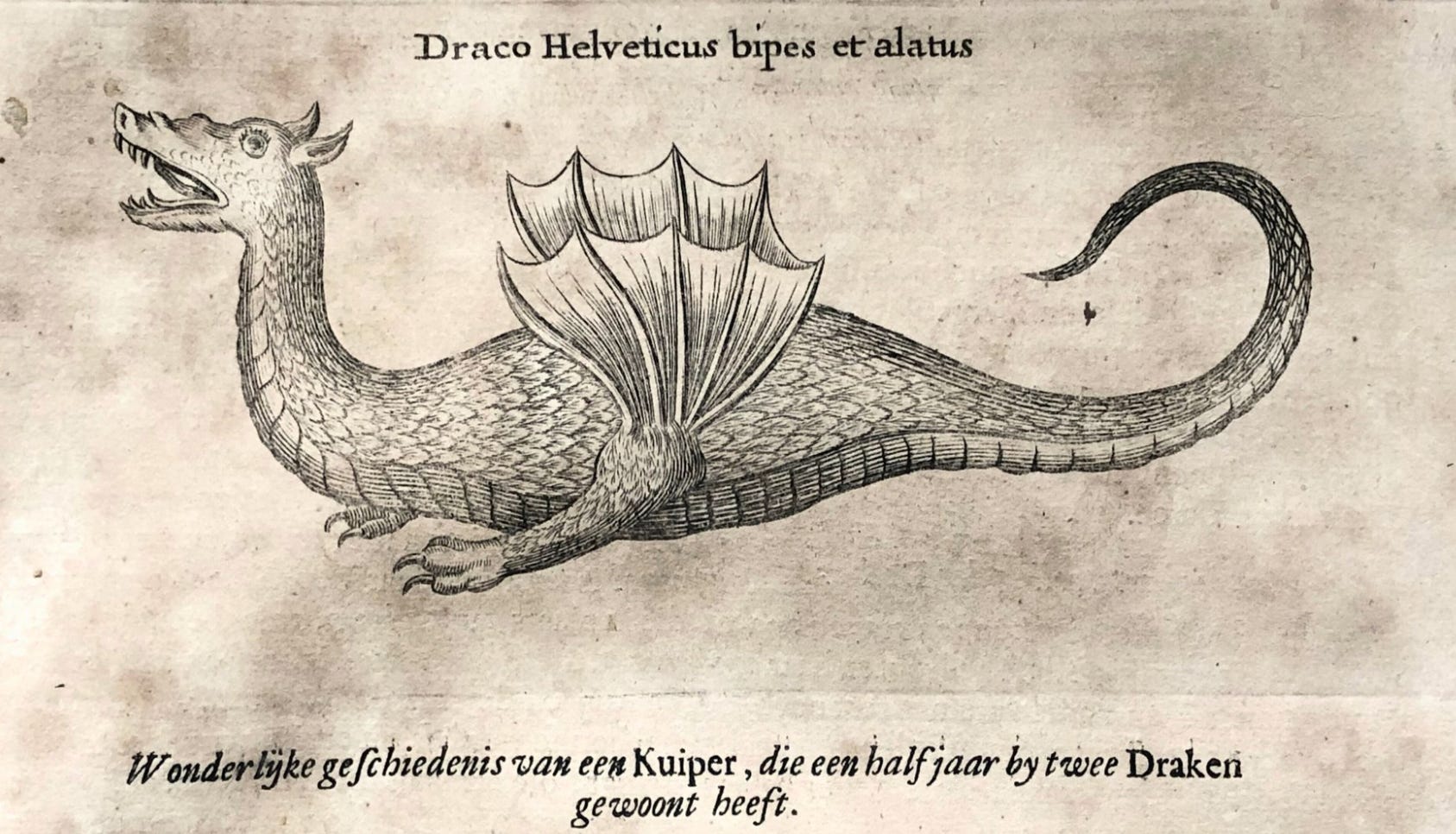
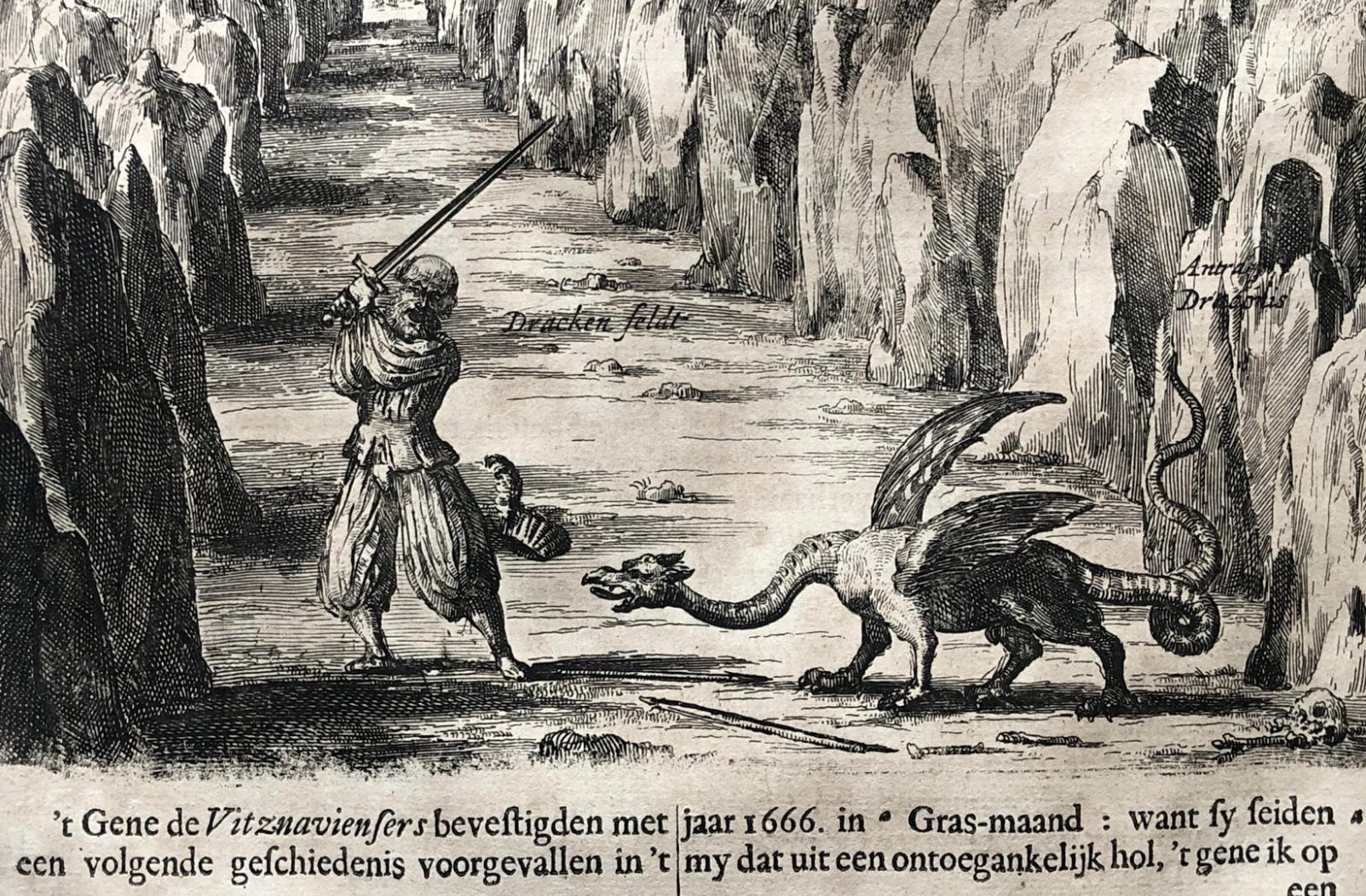
In a seventeenth-century compendium, somewhere between descriptions of intestinal disorders and birds’ eggs, I stumbled upon two illustrated eyewitness reports of a dragon. Nothing was considered so improbable that it did not deserve a beautiful engraving.
Thanks to postmodernism, the denial of objective truth has occupied the front of the classroom for quite some time now. Curiously, however, this has not produced a flourishing diversity of narratives—or even much tolerance for them. The humanities, in particular, have produced a generation that relentlessly imposes its own grand narrative on everyone else. Social media merely completed the process, colonizing thought long before AI entered the scene.
The protagonist of my 2013 novel feared that technology would flatten every unique moment into a template, leaving humanity with little to do but reproduce it endlessly. Like him, I am periodically seized by the desire to disappear without a trace—to retreat to some place where people still think and act originally, rather than according to the latest global mania.
Sadly, after travelling thousands of kilometres in search of such places, I found nowhere whose streetscape advertised a single approved opinion quite so demonstratively as in my home country, the Netherlands. Whether it is a government billboard advising us to scrape every last spoonful from a yoghurt carton for the sake of the climate, or a poster hanging opposite the synagogue in my city, where raised fists announce that they are “the majority”: this country is already rather full when it comes to preaching.
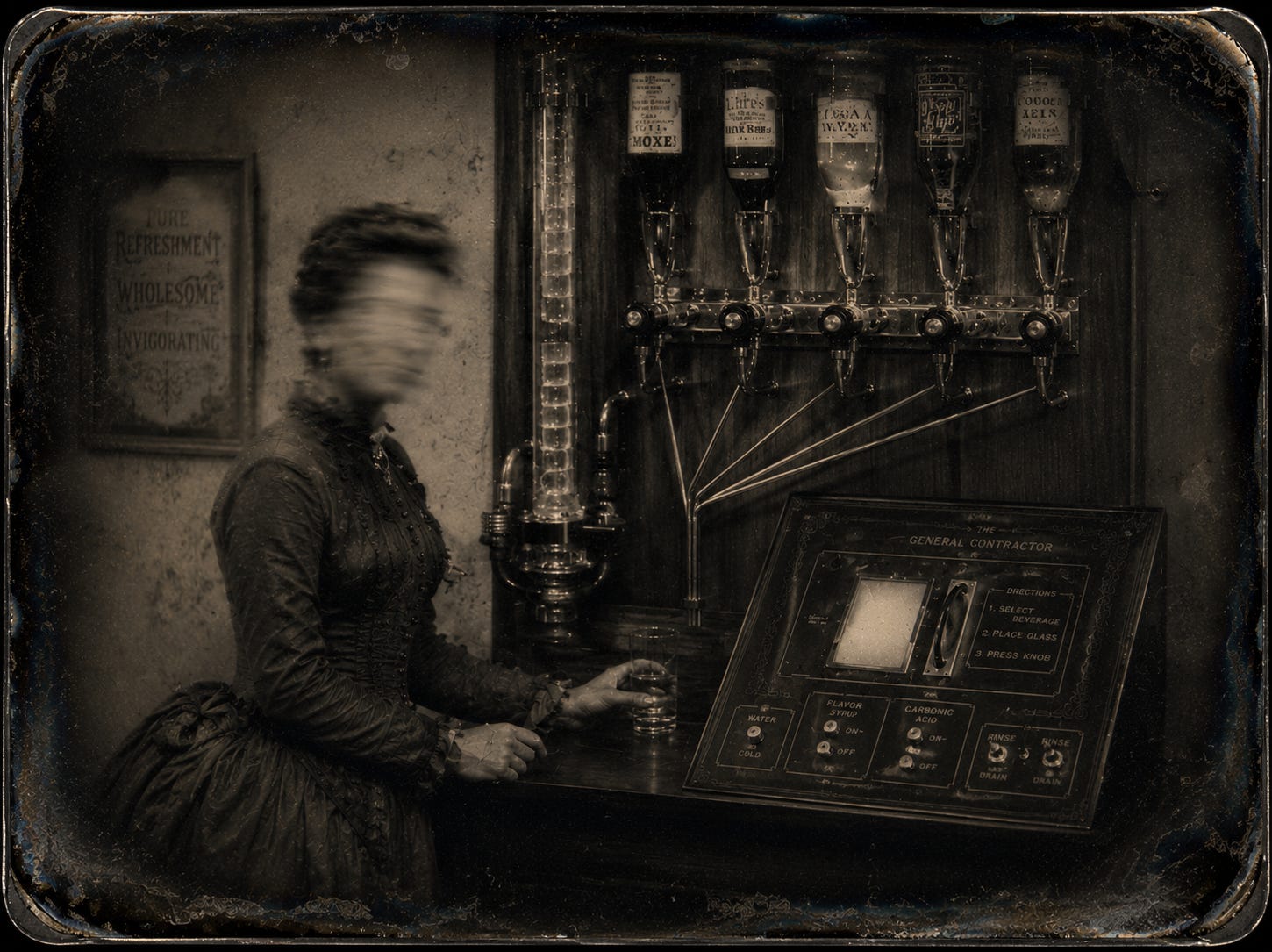
Meanwhile, the flesh remains weak. As I write this, I am nursing a ChatGPT hangover. The plan had been to create a single refined cocktail. Instead, Chat insisted that I first acquire an entire battery of bottles from the liquor store. I obeyed. The first attempt was too bitter. The second too sweet. The third too flat. Every piece of feedback I entered was met with another cheerful correction and a fresh instruction:
“No problem, keep going. This time, add...”
By the fifth glass, the egg-white foam had finally achieved the desired elegance—or was it the sixth? It was already too late when, with Victorian horror, I realised that I had invited Death itself to join me for a drink.